
America’s Department of Homeland Security, the DHS, is a disaster! Its wasting American Tax Paying Dollars on domestic tyrannical behavior like what we’ve seen with ICE. There’s also something dark and covert going on with the DHS and unacknowledged reversed engineered otherworldly technology. While the Department of War distracts the populace by trickling out very small amounts of information about legitimately anomalous events, it secretly cultivates a technologically advanced domestic Iron Heel, well-equipped to abduct individuals and groups on allegations of “pre-crime,” so it can stomp a hole in dissidents and empire rebels who will eventually rise up against this Eschatological Psycho-Oligarchy, whose poisonous, perverted dream of a technocracy is spearheaded by TransHumanists.
We all have to reject this lunacy and go back to a path, maybe imperfect but better than the Empire’s, laid down for us by earlier statesmen like the Roosevelts, Kennedys, and others.
I propose that we take half of the Military Budget, deconstruct the DHS, allocate that half to the DHS, and then reconstruct the DHS as something actually beneficial and useful to Americans.
Here is my suggestion:
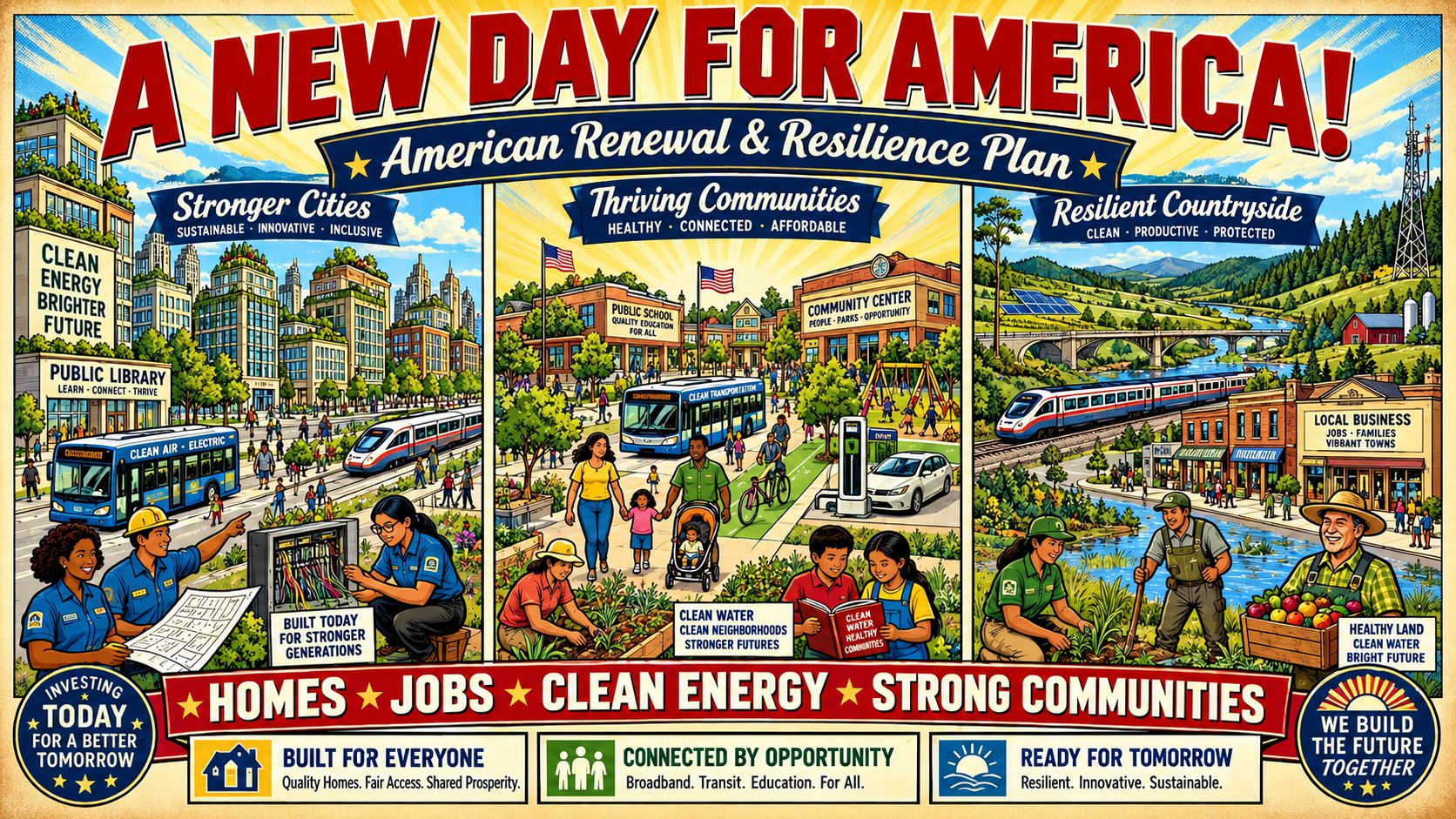
The American Renewal and Resilience Plan is a Solution Plan to at least some of America’s Problems.
This program could combine the New Deal’s three objectives—relief, recovery, and reform—with modern goals:
- Relief: paid employment, housing assistance, health care, training, and disaster recovery.
- Recovery: infrastructure, clean energy, broadband, housing, transportation, and environmental restoration.
- Reform: civil-liberties protections, transparent procurement, stronger labor rights, emergency-preparedness standards, and democratic oversight.
The original WPA ultimately employed roughly 8.5 million people on schools, roads, hospitals, parks, airports, and cultural projects. Its major weakness was that it sometimes sacrificed efficiency for employment and excluded or disadvantaged groups. A modern program should retain the employment mission while using competitive wages, professional engineering, independent audits, and nondiscrimination rules.
1. Reorganize the Federal Departments
A. Create a Department of Civilian Homeland Resilience
This department would absorb or coordinate the civilian portions of DHS concerned with:
- FEMA disaster response and mitigation
- CISA infrastructure resilience and cyber defense
- emergency communications
- public-health and continuity planning
- critical-infrastructure standards
- community preparedness
- disaster logistics and recovery
It would NOT conduct general domestic surveillance, ordinary law enforcement, or political intelligence operations.

B. Transfer Unrelated Functions
Several DHS components should be placed under departments whose missions better fit them:
- Coast Guard: remain a military service in the Department of Homeland Security or move to the Department of War, subject to a public debate and congressional legislation.
- TSA: remain civilian but be governed through a transportation-security agency with stronger passenger-rights protections.
- FEMA: become an independent Federal Emergency and Climate Resilience Administration.
- CISA: become a civilian Cybersecurity and Infrastructure Agency with a narrow defensive mission.
- Secret Service: remain a separate protective and financial-crimes agency with independent oversight.
- Immigration enforcement: remain in a separately authorized justice or border-services structure, with clear statutory limits and judicial accountability.
A homeland-resilience department should not simultaneously function as a disaster agency, immigration-enforcement agency, intelligence organization, transportation police force, and public-works ministry.
C. Establish a National Renewal Administration
The public-works portion should be a separate entity modeled partly on the WPA, PWA, CCC, TVA, and modern infrastructure agencies. It would coordinate with states, tribes, cities, unions, colleges, and nonprofit organizations rather than command local communities from Washington.
Its initial bureaus could include:
- Housing and Community Development
- Bridges, Roads, and Public Transit
- Broadband and Digital Infrastructure
- Water, Plumbing, and Sanitation
- Climate Adaptation and Conservation
- Libraries, Parks, and Civic Facilities
- Energy and Building Modernization
- Workforce Training and Apprenticeships
- Public Health and Community Services
- Arts, Culture, and Historic Preservation

2. Design the Civilian Service Program
The proposed workforce could be called the American Civilian Service Corps. It should be voluntary, civilian, nonpartisan, and open to citizens and lawful residents where legally appropriate—not restricted in a way that creates unnecessary barriers to public service.
Benefits
Participants will receive:
- competitive wages tied to local prevailing wages
- free health, dental, mental, and behavioral-health coverage
- retirement contributions
- paid education and credentialing
- transportation assistance
- free childcare support
- free meals during work shifts
- safe transitional housing where needed
- free housing on Civilian Service Campuses
- portable benefits after leaving the program
Free housing, meals, and medical care would be especially useful for residential conservation, disaster-response, and remote infrastructure crews. They should be treated as compensation benefits—not as a system of compulsory communal living.
Training
Training should resemble a professional Civilian Academy rather than Military Boot Camp:
- workplace safety and first aid
- physical conditioning appropriate to the job
- construction and technical skills
- cybersecurity hygiene
- emergency-response procedures
- conflict de-escalation
- disability awareness
- civil rights and constitutional law
- ethics and anti-corruption
- respectful workplace conduct
- environmental and cultural-resource protection
There should be no military ranks, weapons training, military discipline, domestic-policing role, or requirement to obey unlawful orders.
Types of service
Participants could work as:
- electricians, plumbers, welders, and carpenters
- engineers, surveyors, architects, and inspectors
- broadband technicians
- emergency logisticians
- park and watershed crews
- public-health aides
- librarians and digital-literacy instructors
- nursing and elder-care assistants
- transit maintenance workers
- software and data-security specialists
- artists, writers, historians, and cultural archivists
The WPA’s arts programs demonstrated that public employment need not be limited to manual construction; a modern program should include cultural, educational, scientific, and care work.

3. Replace Military Bases with Civilian Service Campuses
A National Network of Facilities will be built with the goal of at least three Campuses in EVERY state.
Optional use of a tiered network:
- Regional resilience campuses: approximately 50–75 nationwide for training, equipment, emergency warehousing, and specialized construction.
- State service hubs: one or more in every state, depending on population, geography, disaster risk, and existing federal facilities.
- Local project offices: placed in cities, rural counties, tribal areas, and territories.
- Mobile teams: for wildfires, floods, hurricanes, infrastructure failures, and public-health emergencies.
Existing usable Military Bases, vacant federal properties, colleges, community colleges, and underused industrial sites will be reused before building new campuses.
Each residential campus should include:
- dormitories or apartments
- dining facilities
- clinics
- childcare
- classrooms and workshops
- recreation areas
- union or worker-representative offices
- public transit access
- independent ombuds services
- accessible facilities for disabled workers
The campuses should remain open to public oversight and should NOT become closed, militarized compounds.

4. Fund the program gradually at first without simply transferring half the defense budget
Redirecting half of a $1.51 trillion defense topline would imply roughly $755 billion annually. That is too large to shift immediately and would require major changes to defense strategy, procurement, force structure, pensions, nuclear policy, and congressional appropriations. The $1.51 trillion number cited for FY2027 includes a proposed $1.15 trillion discretionary national-defense amount plus $350 billion in reconciliation funding.
A more practical approach would be phased funding:
| Phase | Annual public investment | Primary purpose |
|---|---|---|
| Years 1–2 | $100–150 billion | planning, hiring, pilot projects, disaster mitigation |
| Years 3–5 | $200–300 billion | national workforce expansion and major infrastructure |
| Years 6–10 | $300–450 billion | housing, rail, water, broadband, energy, and climate systems |
Potential funding sources:
- defense procurement reductions identified through independent audits
- cancellation of redundant weapons and low-priority programs
- a portion of defense-related reconciliation funding
- infrastructure bonds
- green bonds and a national infrastructure bank
- higher taxes on very high incomes, excess corporate profits, and financial transactions
- carbon or pollution fees returned partly to households
- land-value capture around rail stations
- savings from energy-efficient federal buildings
- public-private partnerships only where ownership and pricing remain publicly accountable
Congress should create a Defense-to-Resilience Conversion Fund rather than giving the executive branch unilateral authority to move money. Every transfer should require congressional authorization, public reporting, and a national-security review.

5. Build a Ten-year project portfolio
Housing
The program could:
- construct small, durable, energy-efficient homes
- convert vacant commercial buildings into apartments
- expand public and cooperative housing
- use 3D printing selectively where it is cheaper and code-compliant
- establish community land trusts
- build modular accessible homes
- provide weatherization and heat-pump retrofits
- prohibit employer-controlled housing from becoming a condition of continued employment
Five-story tall “tiny-home parking structures” will be mass produced in denser population areas as well as apartments and small homes. Large homes will no longer be constructed or implemented because of the waste of space involved.
Roads, Bridges, and Transit
Prioritize:
- repair before expansion
- structurally deficient bridges
- rural roads and evacuation routes
- bus rapid transit
- regional rail
- high-speed rail corridors with sufficient population and ridership
- safe pedestrian and bicycle networks
- freight-rail modernization
- universal accessibility
A national high-speed-rail program should begin with corridors where demand, travel time, and construction costs justify the investment rather than promising a line in every state immediately.
Broadband and Telecommunications
Build a publicly supported, open-access fiber network with:
- universal service obligations
- affordable wholesale access
- rural and tribal deployment priorities
- resilient underground or hardened routes
- community broadband options
- strong cybersecurity
- transparent outage reporting
- no political surveillance function
Water, Plumbing, and Sanitation
Projects should include:
- replacement of lead service lines
- modern wastewater systems
- leak reduction
- stormwater separation
- rural water systems
- public drinking fountains
- accessible public restrooms and showers
- cooling and warming centers
- water-reuse systems where appropriate
Public restrooms should be designed for safety through lighting, attendants, emergency call systems, regular maintenance, and privacy—which will include publicly displaying identifiable images of everyone entering them. Exterior cameras should cover entrances and surrounding public areas also, with strict retention limits and NO facial-recognition database. Screens outside displaying visitors entering will keep their use secure, protected, and safe from vandalism and crime.
Libraries, Parks, and Civic Spaces
Every city will be getting upgraded to have at least three libraries that could serve multiple community functions. A community should have convenient access to:
- libraries and digital-learning centers
- parks and playgrounds
- public meeting rooms
- maker spaces
- cooling centers
- childcare and senior services
- cultural and arts facilities
Climate and Ecological Resilience
A modern CCC-style service could:
- restore wetlands and watersheds
- reduce wildfire fuel loads
- restore forests and grasslands
- expand urban tree canopy
- build living shorelines
- repair levees where justified
- restore floodplains rather than overbuilding them
- install permeable pavement and rain gardens
- create neighborhood retention basins
- improve drought resilience
“Sponge city” methods—porous surfaces, wetlands, retention areas, and underground storage—can be adapted to American geology and climate conditions. They should be tested locally rather than copied wholesale from another country.
Energy-Positive Buildings
Require new public buildings to meet high performance standards:
- passive solar design
- insulation and airtight construction
- heat pumps
- rooftop solar
- battery storage where economical
- low-carbon materials
- daylighting
- water efficiency
- green roofs
- commissioning and post-occupancy performance testing
“Energy-positive” should mean measured annual energy performance, not merely architectural claims.
Digital Public Infrastructure
Develop:
- interoperable transit-ticketing systems
- open data standards
- digital identity systems with minimal data collection
- public-service portals
- emergency-alert networks
- AI tools for maintenance and disaster forecasting
- algorithmic-impact assessments
- human appeal and oversight for automated decisions
Automated systems should never independently determine eligibility for housing, benefits, employment, immigration relief, disaster aid, or policing action.

6. Establish a Civil-Liberties Charter
Because the proposal is intended to move DHS away from authoritarian practices, rights protections must be structural rather than promises.
The charter should provide:
- no domestic political-intelligence mission
- no surveillance based solely on religion, race, ideology, protest, journalism, or association
- warrants for personal-content searches where constitutionally required
- judicial authorization for intrusive surveillance
- strict limits on data retention
- deletion schedules and audit logs
- independent inspectors general
- congressional reporting
- whistleblower protections
- public records access
- independent civil-rights offices
- a private right of action for unlawful surveillance
- bans on political retaliation
- body-camera and use-of-force rules for any authorized enforcement personnel
- no military deployment for ordinary domestic governance
- public notice before major data systems are created
- annual transparency reports
CISA-like cyber defense should focus on protecting networks, hospitals, water systems, elections, transportation, and energy—NOT monitoring citizens’ lawful speech.

7. Prevent Patronage and Corruption
The New Deal produced enduring infrastructure, but it also faced criticism for inefficiency, political favoritism, and uneven treatment of women and racial minorities. A modern successor should address those problems directly.
Safeguards should include:
- competitive project selection
- published scoring criteria
- geographic equity formulas
- union labor standards
- prevailing wages
- minority- and women-owned business participation
- conflict-of-interest disclosures
- independent cost estimates
- fixed-price contracts where appropriate
- project-level public dashboards
- random audits
- inspector-general investigations
- termination for fraud or unsafe work
- community oversight boards
- no political tests for employment
- civil-service hiring and promotion rules

8. Ten-year implementation schedule
Year 1: Authorization and Pilots
- pass the Civilian Homeland Resilience Act
- define DHS’s narrowed mission
- create the National Renewal Administration
- establish civil-liberties and procurement safeguards
- select pilot regions representing urban, rural, tribal, coastal, and disaster-prone areas
- inventory vacant federal property and existing military facilities
- begin lead-pipe, broadband, wildfire, and bridge-repair projects
- Begin 3D Printing Tiny Homes for the One Million Homeless American Citizens
Years 2–3: Workforce and Emergency Resilience
- recruit and train the first 100,000–250,000 participants
- establish regional campuses and mobile teams
- expand flood, wildfire, hurricane, and heat mitigation
- begin public-housing and broadband construction
- create national apprenticeship partnerships
- transfer suitable federal contracts to civilian manufacturing
Years 4–6: Major Infrastructure
- scale housing construction
- modernize water and wastewater systems
- build priority rail corridors
- expand public transit
- construct libraries, parks, and community centers
- deploy open-access fiber
- retrofit public buildings for energy efficiency
Years 7–10: National Integration
- complete high-priority bridge and road repairs
- connect major regional rail corridors
- expand climate-adaptation systems
- evaluate the workforce program independently
- convert successful temporary programs into permanent agencies
- reduce or close programs whose outcomes do not justify their cost

9. Measure success
The program should publish annual results using metrics such as:
- jobs created and retained
- wages and post-program employment
- apprenticeships completed
- housing units built and preserved
- homelessness reduction
- bridge and road condition
- broadband availability and affordability
- lead pipes removed
- flood and wildfire losses avoided
- disaster-response time
- transit ridership
- energy use in public buildings
- emissions reduced
- library and park access
- workplace injuries
- procurement savings
- civil-rights complaints and resolutions
- surveillance requests, approvals, and deletions
The central principle should be: a civilian service for public resilience, NOT a domestic army; public investment with worker dignity, NOT forced labor; and security through strong communities rather than pervasive surveillance.

