America’s Department of Homeland Security, the DHS, is a disaster! Its wasting American Tax Paying Dollars on domestic tyrannical behavior like what we’ve seen with ICE. There’s also something dark and covert going on with the DHS and unacknowledged reversed engineered otherworldly technology. While the Department of War distracts the populace by trickling out very small amounts of information about legitimately anomalous events, it secretly cultivates a technologically advanced domestic Iron Heel, well-equipped to abduct individuals and groups on allegations of “pre-crime,” so it can stomp a hole in dissidents and empire rebels who will eventually rise up against this Eschatological Psycho-Oligarchy, whose poisonous, perverted dream of a technocracy is spearheaded by TransHumanists.
We all have to reject this lunacy and go back to a path, maybe imperfect but better than the Empire’s, laid down for us by earlier statesmen like the Roosevelts, Kennedys, and others.
I propose that we take half of the Military Budget, deconstruct the DHS, allocate that half to the DHS, and then reconstruct the DHS as something actually beneficial and useful to Americans.
Here is my suggestion:
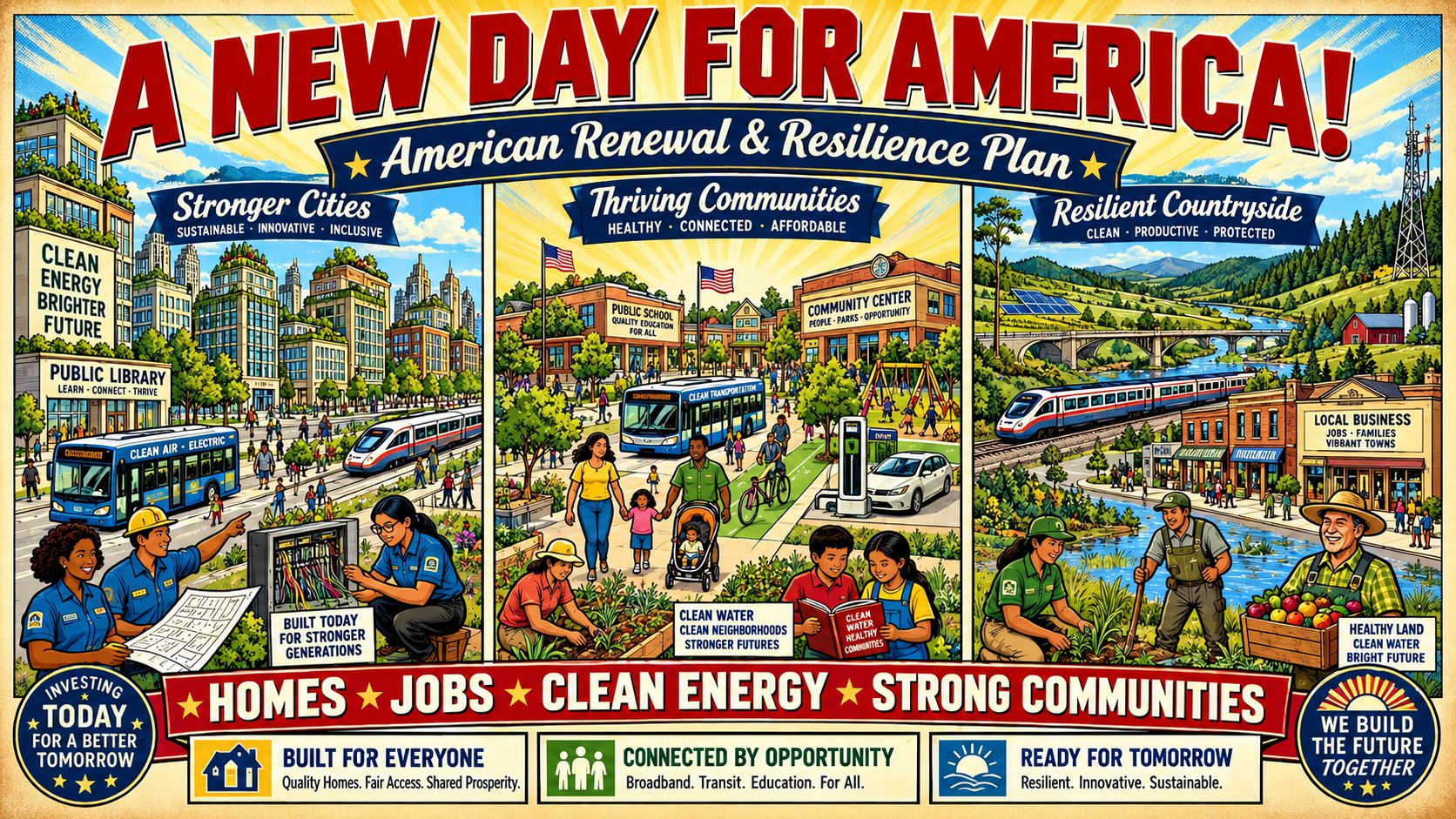
The American Renewal and Resilience Plan is a Solution Plan to at least some of America’s Problems.
This program could combine the New Deal’s three objectives—relief, recovery, and reform—with modern goals:
- Relief: paid employment, housing assistance, health care, training, and disaster recovery.
- Recovery: infrastructure, clean energy, broadband, housing, transportation, and environmental restoration.
- Reform: civil-liberties protections, transparent procurement, stronger labor rights, emergency-preparedness standards, and democratic oversight.
The original WPA ultimately employed roughly 8.5 million people on schools, roads, hospitals, parks, airports, and cultural projects. Its major weakness was that it sometimes sacrificed efficiency for employment and excluded or disadvantaged groups. A modern program should retain the employment mission while using competitive wages, professional engineering, independent audits, and nondiscrimination rules.
1. Reorganize the Federal Departments
A. Create a Department of Civilian Homeland Resilience
This department would absorb or coordinate the civilian portions of DHS concerned with:
- FEMA disaster response and mitigation
- CISA infrastructure resilience and cyber defense
- emergency communications
- public-health and continuity planning
- critical-infrastructure standards
- community preparedness
- disaster logistics and recovery
It would NOT conduct general domestic surveillance, ordinary law enforcement, or political intelligence operations.

B. Transfer Unrelated Functions
Several DHS components should be placed under departments whose missions better fit them:
- Coast Guard: remain a military service in the Department of Homeland Security or move to the Department of War, subject to a public debate and congressional legislation.
- TSA: remain civilian but be governed through a transportation-security agency with stronger passenger-rights protections.
- FEMA: become an independent Federal Emergency and Climate Resilience Administration.
- CISA: become a civilian Cybersecurity and Infrastructure Agency with a narrow defensive mission.
- Secret Service: remain a separate protective and financial-crimes agency with independent oversight.
- Immigration enforcement: remain in a separately authorized justice or border-services structure, with clear statutory limits and judicial accountability.
A homeland-resilience department should not simultaneously function as a disaster agency, immigration-enforcement agency, intelligence organization, transportation police force, and public-works ministry.
C. Establish a National Renewal Administration
The public-works portion should be a separate entity modeled partly on the WPA, PWA, CCC, TVA, and modern infrastructure agencies. It would coordinate with states, tribes, cities, unions, colleges, and nonprofit organizations rather than command local communities from Washington.
Its initial bureaus could include:
- Housing and Community Development
- Bridges, Roads, and Public Transit
- Broadband and Digital Infrastructure
- Water, Plumbing, and Sanitation
- Climate Adaptation and Conservation
- Libraries, Parks, and Civic Facilities
- Energy and Building Modernization
- Workforce Training and Apprenticeships
- Public Health and Community Services
- Arts, Culture, and Historic Preservation